



New Paper: “Cancer Incidence vs. Population Average Sleep Duration on Spring Mattresses”
Advanced Studies in Medical Sciences, Vol. 2, 2014, no. 1, 1 – 15
HIKARI Ltd, www.m-hikari.com
http://dx.doi.org/10.12988/asms.2014.3810
Cancer Incidence vs. Population Average Sleep
Duration on Spring Mattresses
Örjan Hallberg 1,*, Paavo Huttunen 2 and Olle Johansson 3
1*: Independent Research
2: Optoelectronics and Measurement Techniques
Department of Electrical Engineering, University of Oulu
3: The Karolinska Institute, The Experimental Dermatology Unit
Department of Neuroscience
1*: Brattforsgatan 3, 123 50 Farsta, Sweden
2: P.O. Box 4500, FI-90014 Finland
3: 17177 Stockholm, Sweden
*) Corresponding author. e-mail: [email protected]
Copyright © 2013 Örjan Hallberg, Paavo Huttunen and Olle Johansson. This is an open access article distributed under the Creative Commons Attribution License, which permits unrestricted use, distribution, and reproduction in any medium, provided the original work is properly cited.
Abstract
Objective: To review published data about breast cancer and average life time sleep duration on wave-reflecting spring mattresses, and with rates reported before body resonant radiation were at all emitted from broadcasting transmitters, to determine any correlation.
Methods: We collected cancer trend data from cancer registries in Sweden, Denmark, Japan, and the United States. Data on cancer incidence and sleeping habits were collected by a literature survey. Hazard rates (HR) of breast cancer vs. effective sleep duration in body-resonant radiation were plotted to determine the significancelevel of collected data. Practical measurements of electromagnetic fields were also performed above beds with metal spring mattresses.
Results: Breast cancer HR increased with sleep duration in the United States. In Japan, where mainly metal-free mattresses are used, HR decreased with increased sleep duration. Earlier studies on melanoma have identified a strong association between incidence and time spent in body-resonant radiation. All collected data on breast cancer and melanoma show a significant association with sleep duration on wave reflecting metal spring mattresses. Measurements also showed that the electric field increased by distance above the mattress as expected due to standing wave effects.
Conclusions: Body-resonant radiation may influence health negatively if concentrated by metal spring mattresses during sleep at night. A simple way to reduce cancer risks may be to exchange the metal spring mattress for a non-metal one like a futon or a foam type.
Keywords: Breast cancer, sleep duration, melanoma, prostate cancer, radiation, metal spring mattress, foam mattress
Intriduction
In Denmark, between 1943 and 1955, the age-standardized incidence of breast cancer was stable at around 42/100,000 person-years (py). However, from 1958 onward, the incidence increased over time, just as it did in Sweden. Despite increasing screening and lifestyle changes, there is no conclusive explanation for this rather sudden increase in breast cancer incidence after 1955, which was also noted for skin melanoma and some other cancers. In 2002, it was hypothesized that body-resonant broadcast radiation might act as a threat to the immune system of people who tended to sleep for years in resonance with an FM radio main transmitter [2] If a person sleeps on a metal spring mattress, reflected and standing waves could also explain the fact that the left side of the body in general is more prone to breast cancer [11-14] and melanoma [1] than the right side of the body. This can be explained by the fact that people tend to sleep for longer times on the right side than on the left side, so that the right side is closer to the field attenuating metal than the left side is [3]. Consequently, it might be expected that countries in which a large proportion of the population sleep on wave reflecting mattresses would have higher incidences of breast cancer and melanoma than countries in which people sleep mainly on nonmetal beds, such as futons in Japan. A survey of data from different parts of the world showed that this indeed was the case; a high prevalence of metal spring beds corresponded to a high cancer incidence, and vice versa [4].
Traditionally, a good night’s sleep has been associated with good health, since the body needs time every night for maintenance tasks, such as repairing the DNA in damaged cells. Short sleep duration might therefore be expected to increase breast cancer risk, while a long, good night’s sleep would decrease the risk. However, if the sleep occurs in a detrimental environment, in which the body’s repair capacity is temporarily reduced, we would expect longer sleep duration to increase the risk, so that the risk vs. sleep duration graph would appear U-shaped [15]. Information regarding the relationship between mattress types and sleep duration vs. cancer incidence should strengthen or weaken previously published hypotheses regarding the effect of broadcast radiation on public health [2-4].
If the hypothesis of an association between increased cancer incidence and wave-reflecting beds is correct, then one must question whether sleeping for more hours really is good for your health. It might be better to stay in bed for as short a period as possible or just to get rid of the metal spring mattress in order to minimize the cancer risk from continuous radiation stress on the body’s DNA repair capacity. Thus, our objective was to review the literature related to breast cancer and sleep duration to see if the breast cancer risk is also consistent with reported use of metal spring mattresses and with data reported before body-resonant radio broadcasting became introduced.
Methods
The cancer incidence rates prior to 1955 in Sweden and Denmark occurred at a time when body-resonant radiation from FM radio transmitters was almost non-existent. Thus, these data are representative of zero sleep duration in a body-resonant radiation environment. Current cancer incidence rates were related to average sleep duration of 7.5 hours in a resonant environment. The hazard ratio (HR) of cancer incidence at zero sleep duration was defined as the ratio between the cancer incidence before 1955 and the incidence at present.
In the USA and the Nordic countries the use of metal spring mattresses is around 70 % of the population. If only, say 30 %, of the population in a country is using metal spring mattresses, this can be seen as if the whole population only sleeps for 30/70*7,5 hrs = 3.3 hrs per night in a body-resonant environment. Data from ref [4] were used to estimate such equivalent sleeping times.
In 2005, all 75 year old people had been living for 50 years in the new radiating environment we were blessed with from 1955 and onwards. Thus, in 1965 this age group had only been sleeping in this environment during ten years. If, in 2005, the same age group have been sleeping 7,5 hours per night in body-resonant radiation the last 50 years, they had in 1965 in average during the last 50 years only slept for 10/50*7.5 = 1.5 hours per night in the same environment. A corresponding approach was followed using age-standardized rates for the whole population instead of age-specific rates for one specific age group.
To test the assumption, that the hazard rate (HR) vs. the average sleep duration in body-resonant radiation also fits with HR vs. reported actual sleep duration and reported use of wave reflecting spring mattresses, we plotted all data in the same graph.
This study did not involve any individuals and did not influence sleeping habits among any individuals in the population. Instead, we collected already published results regarding sleep time and cancer incidence to compare those data with our hypothesized relationship between sleep time and breast cancer risk. Thus, there was never a need for any ethical approval of our study at all.
Results
We searched for articles related to sleep duration and breast cancer, prostate cancer, and general mortality on PubMed. Data about cancer incidence were retrieved from cancer registries. The HRs of breast cancer, prostate cancer, and general mortality were plotted against reported sleep durations from <6 to >10 hours and normalized to the reported US average cancer incidences and mortality. Figure 1 shows the age-standardized rates of breast cancer among women in Denmark, Sweden, Japan, and the United States. Denmark released breast cancer incidence data from 1943 onward, while data from Sweden were only available from 1958 onward. The incidence of breast cancer was quite stable at approximately 42/100,000 py in Denmark until around 1955, at which point it followed the same trend as reported in Sweden. Currently, the breast cancer incidence is around 80/100,000 py in Sweden and 95/100000 py in the United States, while in Japan it is approximately 42/100,000 py.
Similarly, Figure 2 shows melanoma trends in Denmark, Sweden, Japan, and the United States. As for breast cancer, the incidence of melanoma before 1955 remained steady in Denmark and increased thereafter, as in Sweden. Data from Sweden from 1911 to 1913 revealed an incidence of 1/100,000 py (shown as a blue triangle in the graph). Japan reported remarkably low and stable current rates of melanoma, even lower than those reported by Sweden from 1911 to 1913.
Figure 3 provides the HRs of breast cancer vs. sleep duration. Included is reported HRs for breast cancer relative to nominal sleeping duration of 7.5 hours in the United States [12, 13]. Since the left side of the body is exposed to standing waves for longer periods each night [3], we also plotted the corresponding HRs for men and women based on detailed data [3] in the same graph. Equivalent average sleep durations in standing waves based on reported use of metal spring mattresses in different countries were plotted [4]. Detailed background data can be found in Tables I and II. Finally, we tested the hypothesis that the HR-trend vs. life-time sleep duration on spring mattresses in a body-resonant radiation would follow a similar route as e.g. breast cancer incidence vs. actual sleep duration in 2005. This set of data is shown separately in Figure 3.
Corresponding data for melanoma were also collected and are plotted in Figure 4. See Table III for an example with calculations explained.
Figure 5 graphs the relationship between sleep duration and breast cancer in Japan and Singapore [10, 14], as well as prostate cancer in Japan [11].
In order to test the hypothesis, that incident and reflected waves of horizontally polarized radiation cancel each other close to a metal structure and might add as standing waves further up from it, we measured the electric fields of FM-radio signals above beds with and without a metal spring mattress. A horizontal monopole antenna (0.5 metre) was connected to spectrum analyser (GW Instek, GSP 827, Taiwan). The antenna voltage signal peak in the spectrum was read on the dB?V scale and reduced to millivolts. The electric field intensity E [mV/m] was approximated using equation E = 2U/l, where U is the signal and l is the length of the antenna. The distance to the FM broadcasting transmitter was 20 km and the measurements were performed in a bedroom with a concrete floor in a house built on a hill.
In reality we also have to consider that both the bed and the body are in resonance forming two resonant circuits coupled to each other, thereby strengthening the currents. Close to the metal the currents in the body and in the metal are in opposite directions, cancelling each other while higher up they tend to cooperate.
Figure 6 shows that the radio frequency electric field was lower than average close to the mattress, while it increased with the height above the bed. In this case the increase was largest above the end of the mattress. Indication of standing waves of FM-radio signals in the bedroom was quite different above a wooden bed without a metal spring mattress. This is assumed to be the outcome from reflected and standing waves above a metal structure [8]. Field attenuation between incident and reflected waves causes low fields close to the metal mattress while the fields are increasing by distance above the mattress. Non-reflected fields above a wooden bed will show higher strength but will not cause standing waves constantly disturbing the same part of a human body resting on top of the bed. Thus, these measurements show clearly, that a metal spring mattress is capable of changing electromagnetic fields and creating new standing waves, which may disturb the immune system and be harmful to health if a person is sleeping in such an environment. Some persons may feel the effect soon but by some others the symptoms may become apparent only after many years.
Discussion
Our results suggest that the most common sleep environment in Japan is healthier than that of Western countries. In both regions, too little sleep is associated with an increased risk of breast cancer and general mortality, while longer sleep duration seems to have some positive health effects in Japan and some negative health effects in Western countries.
The HR data from the United States [13] were normalized to HR = 1 at 7.5 hours of sleep duration to match the data provided by McElroy et al. [12]. The association noticed between sleep duration and breast cancer is significant (Figure 3). Japan today has approximately the same breast cancer incidence as Denmark and Sweden had before 1955 (Figure 1). Studies of mortality vs. sleep duration in the US show increasing mortality by sleep durations longer than 7.5 hours [15]. The calculated HRs for breast cancer and melanoma based on life time sleep duration on spring mattresses in a body-resonant environment strongly supports the other data collected on HR vs. sleep duration.
The association between melanoma of the skin and environmental change since 1955 was investigated previously [2]. The currently reported melanoma incidence of 0.4/100 000 py in Japan is even less than it was in Denmark and Sweden before 1955 (see Figure 2, in which incidence data from 1911–1913 are plotted). According to the findings presented in reference [4], breast cancer and melanoma are most prevalent in countries that predominantly use modern metal spring mattresses, and least prevalent in countries in which these types of mattresses are less commonly used, such as Japan. A linear extrapolation of the melanoma rate from 1955 with reference to the melanoma rate today, normalized to 7.5 hours of sleep duration, suggests that the melanoma incidence would be 24% higher with a sleep duration of 9.5 hours in Western countries. Figure 4 gives HR’s for melanoma vs. population average sleep time on spring mattresses from different countries.
The statistics regarding mortality vs. sleep duration10 are compelling and warrant further investigation of differences among regions. The mean life span of Swedish men and women stopped increasing after 1955 and did not begin to increase again until after 1980. No such trend break was noticed in Japan, where women today have a median life span of close to 90 years, while the median life span of women is only 83 years in Sweden. A trend-break similar to the one in Sweden was also noticed for men in Switzerland.
Several other observations from earlier melanoma studies support the hypothesis of an increased cancer risk due to body-resonant radiation from broadcasting transmitters [5-9].
To explore whether sleeping on metal spring mattresses has a direct effect on the body’s ability to respond to cancer, DNA repair capacity tests could be performed on blood samples from age- and sex-matched persons in different countries or from people using different types of beds in one country. These tests could provide clinical data that might be useful in elaborating our hypothesis that metal spring mattresses concentrate body-resonant radiation, leading to higher incidences of some types of cancer. It might also be the case that the repair capacity is only temporarily disturbed during night due to skin currents and not seen in blood tests taken during day-time; such possibilities must, of course, be controlled for. If the hypothesis, about a temporarily or permanently disturbed DNA repair capacity from night-long exposure to standing waves from body-resonant
broadcasting radiation, holds to be true, there is an immediate opportunity to reduce the cancer burden in the society. This could simply be done by changing bed standard from metal spring mattresses to non-metal foam mattresses. The effect from such a change could be estimated in a similar way as was done to model the effect of reduced repair efficiency from the introduction of FM broadcasting in the 50’s [7].
Conclusions
1. Too short average sleep duration has negative health effects and may result in an increased mortality.
2. A longer time in bed than the average 7.5 hours per night may increase the risk of breast cancer and general mortality in Western countries, but not in Japan, where the risks for breast and prostate cancer are further reduced with longer sleep times.
3. The data reported in this and previous papers support the hypothesis that the bed environment may be an important breast cancer risk factor, and that reflected and standing radio waves from metal spring mattresses should be avoided, e.g., by sleeping on mattresses that do not contain metal springs, as is common in Japan. Studies of a possible association between melanoma incidence and sleep duration should also be performed. A deeper study including detailed measurements of electrical fields around a human body resting on a metal spring mattress seems highly motivated.
4. If the hypothesis holds to be true there is an opportunity to substantially reduce the cancer burden in the society by relatively simple means.
Abbreviations used
HR = Hazard Ratio
FM radio = Frequenzy Modulated radio, most oftern using the 87-107 MHz broadcasting band
DRC = DNA Repair Capacity
Conflict of Interest Statement
The authors know of no conflict of interest related to this work.
Authors’ Contributions
As the main author ÖH contributed by: Study design, Data collection (Figs 1-4), Data analysis, Interpretation of results, and Preparation of the manuscript. PH contributed by: Data collection and EMF measurements (Fig 5), Data analysis, Interpretation of results and Preparation of the manuscript. OJ contributed by: Data analysis, Interpretation of results, and Preparation of the manuscript.
Acknowledgements
The authors thank University of Oulu, Finland for granting funds for any publication costs. Apart from the support from University of Oulu, Örjan Hallberg and Paavo Huttunen received no other funding for this study.
Olle Johansson was supported for this study by grants from the Cancer and Allergy Foundation (Cancer- och Allergifonden), and Einar Rasmussen, Kristiansand S, Norway, Brian Stein, Melton Mowbray, Leicestershire, UK, The Irish Campaign against Microwave Pollution, and the Irish Doctors Environmental Association (IDEA; Cumann Comhshaoil Dhoctúirí na hÉireann) are gratefully acknowledged for their general support.
REFERENCES
1. De Blackam C, Ho W L, Acton C, Murphy G, Kneafsy B, Hill A D K. Prevalence of left-sided melanomas in an Irish population, Ir J Med Sci, 180 (2011), 727-30
2. Hallberg Ö, Johansson O, Melanoma incidence and frequency modulation (FM) broadcasting. Arch Environ Health. 57 (2002),32-40
3. Hallberg Ö, Johansson O. Sleep on the right side—Get cancer on the left? Pathophysiology. 17 (2010), 157-60
4. Hallberg Ö. Bed types and cancer incidence. Letter to the Editor. Pathophysiology, 17 (2010), 161
5. Hallberg Ö.,Johansson O. Malignant Melanoma of Skin – Not a Sunshine Story! Med Sci Monit. 10 (2004), CR336-40
6. Hallberg Ö, Johansson O. FM broadcasting exposure time and malignant melanoma incidence. Electromagnetic Biology and Medicine 24 (2005), 1-8.
7. Hallberg Ö. A reduced repair efficiency can explain increasing melanoma rates. European Journal of Cancer Prevention. 17 (2008), 147-52
8. Hallberg Ö. A theory and model to explain the skin melanoma epidemic. Melanoma Research, 16 (2006), 115-8
9. Hallberg Ö, Johansson O. Increasing melanoma – too many skin cell damages or too few repairs? Cancers 5 (2013), 184-204.
10. Kakizaki M, Kuriyama S, Sone T,Ohmori-Matsuda K, Hozawa A, Nakaya N,Fukudo S,Tsuji I. Sleep duration and the risk of breast cancer: the Ohsaki Cohort Study. British Journal of Cancer. 99 (2008), 1502-5
11. Kakizaki M, Inoue K, Kuriyama S, Sone T, Ohmori-Matsuda K, Nakaya N, Fukudo S, Tsuji I. Sleep duration and the risk of prostate cancer: the Ohsaki Cohort Study. British Journal of Cancer. 99 (2008), 176-8
12. McElroy JA, Newcomb PA, Titus-Ernstoff L, Trentham-Dietz A, Hampton JM, Egan KM. Duration of sleep and breast cancer risk in a large populationbased case–control study. J Sleep Res. 15 (2006), 241-9
13. Pinheiro SP, Schernhammer ES, Tworoger SS, Michels KB. A prospective study on habitual duration of sleep and incidence of breast cancer in a large cohort of women. Cancer Res. 66 (2006), 5521-5.
14. Wu AH, Wang R, Koh W-P, Stanczyk FZ,Lee H-P, Yu MC. Sleep duration, melatonin and breast cancer among Chinese women in Singapore. Carcinogenesis. 29 (2008), 1244-8
15. Youngstedt SD, Kripke DF. Long sleep and mortality: rationale for sleep restriction. Sleep Med Rev. 8 (2004), 159-74.
FIGURE LEGENDS

Figure 1. Age-standardized breast cancer incidence in women from Denmark, Sweden, United States, and Japan.

Figure 2. Age-standardized melanoma incidence in Denmark, Sweden, United States, and Japan. Blue triangle represents Sweden in 1911–1913.
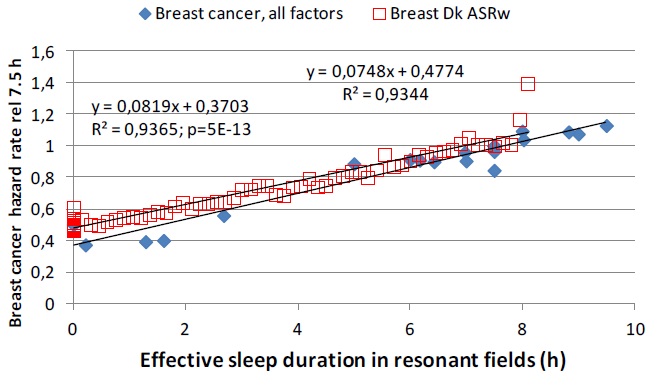
Figure 3. Estimates of hazard ratios of breast cancer vs. sleep duration in a body-resonant radiation environment based on data before 1955, when body-resonant radiation was almost non-existent and on currently reported data. Detailed data are given in Tables I and II. Red squares represent reported HR for the whole population since 1943 based on age standardized data from Denmark with effective average sleep time calculated since 1955.

Figure 4. Estimates of hazard ratios of melanoma vs. sleep duration in a body-resonant radiation environment based on data before 1955, when body-resonant radiation was almost non-existent and on currently reported data. Red squares represent reported HR for the 75 years age group since 1943 based on data from Denmark and Sweden with effective average sleep time calculated since 1955. Examples of data and calculations are given in Table III.

Figure 5. Reported hazard ratio (HR) of breast and prostate cancer incidence in Japan and Singapore vs. sleep duration (normalized to 7.5 hours of average sleep duration, as measured in the United States).

Figure 6. Electric fields measured above a wooden bed without and with a metal spring mattress of 20x140x200 cm. The electric field intensity of FM-radio signals near 100 MHz was measured two times at the same position. A-B: above the middle
of the wooden bed without the mattress; C-D: above the middle of the metal spring mattress; E-F: above the end of the metal spring mattress.

Table I. Equivalent resonant sleeping time and corresponding breast cancer hazard rates (HR).
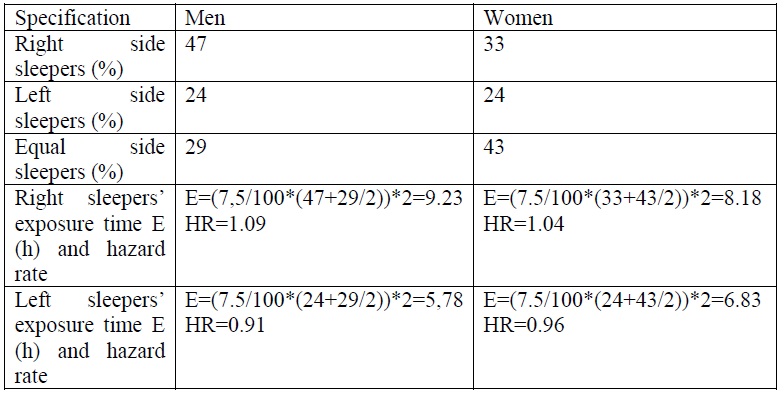
Table 2. Estimate of average sleep time corresponding to the time spent in resonant electric fields for people with different sleep side preferences and corresponding hazard rates (data from ref 8). Right side sleepers have their left side up in elevated fields for longer times etc.
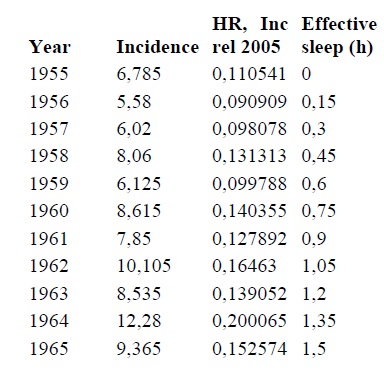
Table 3. Melanoma HR for age group 75 years in Denmark is calculated as Inc(Year)/Inc(2005). Effective sleep time in body-resonant radiation is calculated as (Year-1955)/50*7.5 h.
Received: August 1, 2013
Download paper (PDF)
 Please support our work by making
a tax-deductible donation.
We are 100% donation-based
and need your support
to educate, communicate and analyze
critical developments in this field.
Thanks so much for your help!
Please give generously.
We depend on you.